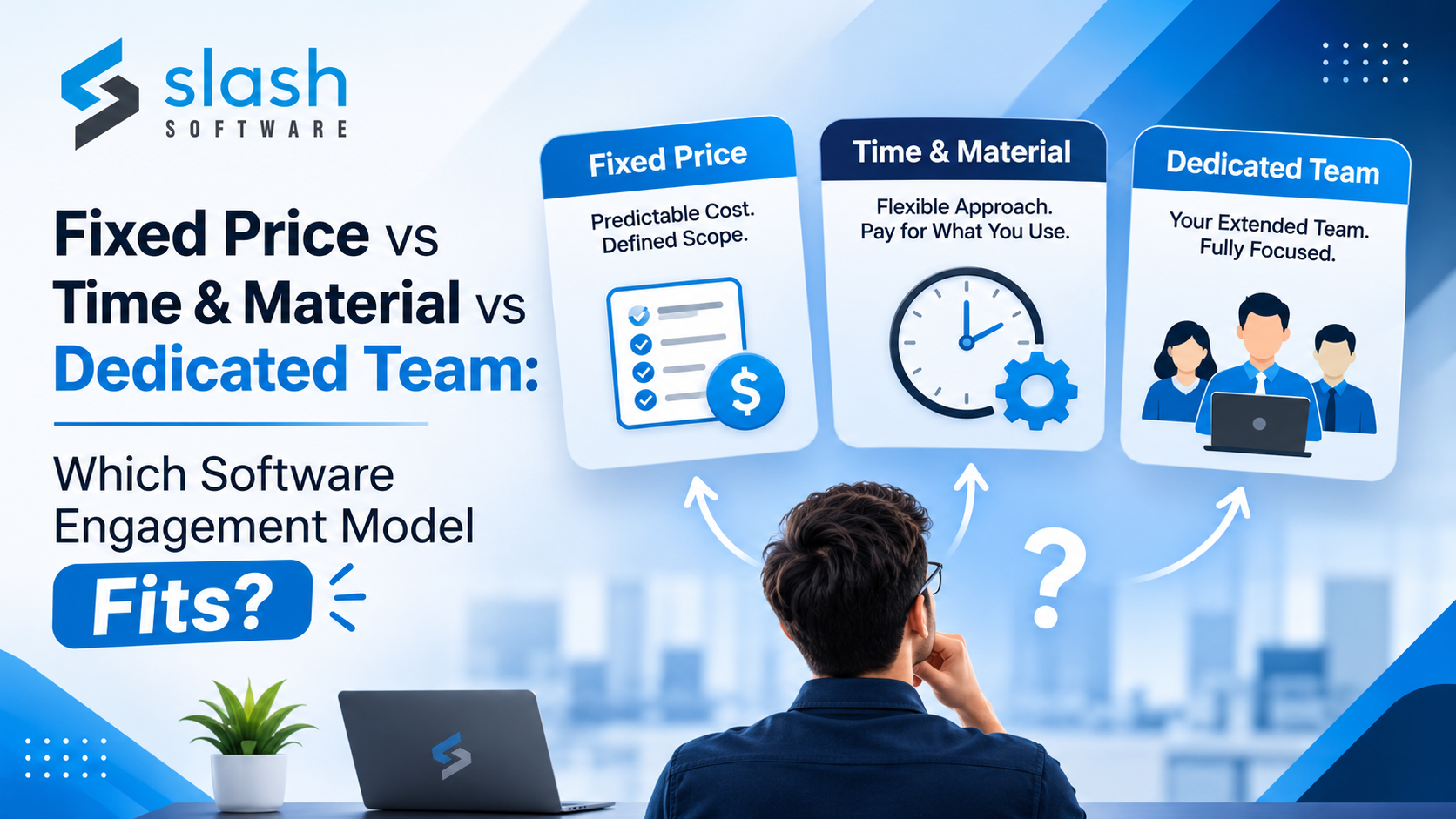



Choosing a software engagement model is not simply a pricing decision. It determines who carries delivery risk, how easily priorities can change, how closely the client must manage the work and whether product knowledge stays with the same team.
The short answer is straightforward:
- Choose fixed price when the scope, timeline and acceptance criteria are clear.
- Choose time and materials when requirements may change or technical uncertainty remains.
- Choose a dedicated team when software development is continuous and retaining product knowledge matters.
The wrong model can create change-request disputes, budget overruns or an underused team. The right model gives both parties enough control without pretending that every software project is predictable.
Short Summary
Fixed price provides the strongest initial budget certainty, but it works only when the scope is mature. Time and materials offers flexibility for evolving projects, although the client must actively manage priorities and spending. A dedicated team is usually best for long-term SaaS, enterprise and product-development roadmaps requiring stable engineering capacity.
Many businesses achieve better results with a hybrid approach, such as time-and-materials discovery followed by fixed-price delivery or a dedicated team.
How Do the Three Engagement Models Compare?
Strictly speaking, these are not three identical categories. Fixed price and time and materials define how work is priced. A dedicated team describes how engineering capacity is assigned, usually through a monthly fee or time-based arrangement.
Businesses still compare them because each creates a different working relationship.
| Factor | Fixed Price | Time and Materials | Dedicated Team |
| Scope | Clearly defined before development | Can evolve during development | Managed through an ongoing roadmap |
| Budget | Agreed in advance | Based on actual effort | Predictable monthly capacity |
| Flexibility | Low to moderate | High | High |
| Client involvement | Moderate | High | High and continuous |
| Change handling | Formal change requests | Backlog reprioritization | Sprint and roadmap planning |
| Knowledge retention | Limited to project duration | Depends on team continuity | Strong |
| Scaling the team | Requires contract changes | Relatively flexible | Designed for scaling |
| Best suited for | Defined projects and integrations | Discovery, modernization and uncertain builds | Long-term products and continuous development |
| Main risk | Incomplete scope or reduced flexibility | Weak cost control | Paying for capacity without a clear roadmap |
No model is automatically better. The best choice depends on how much is known about the project and how likely that knowledge is to change.
The Contract Does Not Remove Uncertainty
A contract can assign financial risk, but it cannot make unclear requirements predictable.
Under a fixed-price arrangement, the development partner accepts more cost risk. The US Federal Acquisition Regulation describes firm-fixed-price contracts as placing maximum cost responsibility on the supplier. It also states that this model is appropriate when specifications are sufficiently clear and performance uncertainty can be estimated. Although this guidance was written for public procurement, the underlying risk principle also applies to private software projects.
If the project contains major unknowns, the development company must either price those risks into the quotation, limit the scope or manage changes through additional charges.
A low fixed quotation does not necessarily mean lower final cost. It may mean that important work has been excluded.
Fixed Price: Predictability Depends on Scope Quality
In a fixed-price engagement, the client and development partner agree on the deliverables, timeline and total cost before development begins.
This model works well for:
- A clearly documented website or application
- A defined third-party integration
- A small MVP with stable features
- A migration with a completed technical assessment
- A product module with measurable acceptance criteria
Fixed price gives stakeholders a clear approval figure. It can also reduce day-to-day budget administration because payment is usually tied to milestones.
However, the model becomes restrictive when user feedback or technical discoveries require the product to change. New functionality generally needs a change request, revised estimate and adjusted timeline.
The quality of the requirements therefore matters more than the contract label. A fixed-price project should document workflows, integrations, user roles, non-functional requirements, exclusions and acceptance criteria.
When Should You Avoid Fixed Price?
Avoid using one fixed price for an entire project when:
- The product idea has not been validated.
- Legacy code has not been inspected.
- Third-party APIs are undocumented.
- AI accuracy requirements are still being tested.
- Stakeholders expect frequent changes.
- Important technical decisions remain unresolved.
UK government guidance on contracting for agile delivery similarly warns that projects with limited information and high uncertainty are less likely to achieve their intended outcomes through a rigid fixed-price structure. It suggests using defined phases or fixed-price sprints when appropriate.
Time and Materials: Flexibility Requires Governance
Under a time-and-materials model, the client pays for the hours worked and any agreed project expenses. The team usually delivers in short iterations while the client reprioritizes the backlog.
This model suits projects where learning is part of delivery, including:
- Product discovery and prototyping
- AI and machine-learning experiments
- Legacy application modernization
- Complex API integrations
- Products shaped by ongoing user feedback
- Projects with changing regulatory or operational needs
The main benefit is flexibility. A feature can be changed, removed or replaced without renegotiating the complete contract.
The risk is weak financial control. Without disciplined backlog management, regular demonstrations and budget reporting, a project can consume more hours without producing enough business value.
The Federal Acquisition Regulation notes that time-and-materials agreements are appropriate when the extent or duration of work cannot be estimated with reasonable confidence. It also highlights the need for oversight and a ceiling price because this structure does not inherently reward cost control.
Private software buyers can apply the same practical controls:
- Set a monthly or phase-based budget ceiling.
- Approve sprint priorities before work begins.
- Review completed software, not only timesheets.
- Track forecasted cost against accepted outcomes.
- Stop or change direction when evidence does not support further investment.
Time and materials should mean flexible delivery, not unlimited billing.
Dedicated Team: Paying for Continuity and Capacity
A dedicated team gives a client consistent access to selected developers, QA engineers, designers or DevOps specialists. The team works on the client’s product for an agreed level of capacity, often full-time and billed monthly.
This model is usually suitable for:
- A SaaS product with a continuous roadmap
- An enterprise platform requiring regular releases
- A startup expecting to develop beyond its MVP
- A business that needs several technical roles
- Long-term modernization or integration programs
- An internal team that needs additional capacity
The primary advantage is knowledge retention. The same engineers become familiar with the architecture, users, business rules and past decisions. Over time, less effort is spent explaining the product before each new feature.
A dedicated team also makes scaling easier. Specialists can be added as the roadmap requires them without starting a separate vendor-selection process for every module.
However, the client is purchasing capacity rather than a guaranteed list of features. The model performs poorly when priorities are unclear, product ownership is absent or decision-makers cannot provide regular feedback.
A dedicated team still needs a roadmap, sprint goals, quality standards and measurable delivery expectations.
Which Model Fits Your Software Project?
Ask four questions before comparing quotations.
1. How Certain Is the Scope?
If the team can describe the workflows, interfaces, integrations and acceptance criteria in detail, fixed price may work.
If important requirements will emerge through testing and feedback, time and materials provides safer flexibility.
2. Is the Work a Project or an Ongoing Product?
A project has a defined completion point. A product continues to evolve after launch.
Fixed price is generally better for bounded projects. A dedicated team is often better for products with an active roadmap, ongoing optimization and regular releases.
3. How Much Client Involvement Is Available?
Time and materials and dedicated teams need an active product owner. Someone must prioritize work, answer questions and review results.
If the client cannot provide that involvement, a tightly defined fixed-price engagement may be easier to manage.
4. Where Does the Greatest Risk Sit?
If missing a defined deadline is the primary risk, a milestone-based fixed-price contract may provide useful accountability.
If building the wrong feature is the larger risk, an iterative time-and-materials approach allows the product to change as evidence emerges.
Three Practical Scenarios
A company wants to connect a documented CRM with its customer portal. The workflows and APIs are known, and acceptance criteria can be tested. Fixed price is a reasonable choice.
A manufacturer wants to modernize a ten-year-old operations system, but the code quality and integration dependencies are unclear. Begin with time-and-materials discovery, establish the technical baseline and then price the delivery phases.
A funded SaaS company has a 12-month roadmap covering new features, infrastructure, integrations and maintenance. A dedicated team offers stronger continuity than issuing separate contracts for every release.
A Hybrid Model Is Often the Most Realistic Choice
Software projects do not need to remain under one commercial model from beginning to end.
A business may use:
- Time and materials for discovery, followed by fixed-price milestones
- Fixed-price sprints with the backlog reviewed between phases
- A dedicated core team with fixed-price specialist work
- A dedicated team with a monthly budget ceiling
- A short paid pilot before committing to a longer engagement
UK agile-contracting guidance specifically recognizes that there is no single commercial approach for every project. It also identifies time-and-materials discovery followed by a more structured delivery model as a practical option when early uncertainty is high.
What Should the Agreement Define?
Regardless of the model, the agreement should clearly cover:
- Deliverables, assumptions and exclusions
- Team roles and expected availability
- Acceptance criteria and quality standards
- Change-request and backlog-management processes
- Reporting, invoices and budget ceilings
- Repository access and intellectual-property ownership
- Security and data-access responsibilities
- Termination, transition and knowledge-transfer terms
- Post-launch support and maintenance
Commercial flexibility cannot compensate for unclear ownership or weak delivery controls.
Build With the Engagement Model Your Project Actually Needs
Slash Software provides custom software development services through flexible engagement structures shaped around project certainty, delivery duration and required engineering capacity. A defined application may suit fixed-price delivery, while an evolving SaaS or enterprise platform may need time-and-materials development or a dedicated team. The goal is not to recommend the largest engagement. It is to match commercial structure with the way the software must actually be built.
Frequently Asked Questions
Is a fixed-price software project always cheaper?
No. Fixed price may include a risk premium, and changes outside the agreed scope can increase the final cost. It is most economical when requirements are complete and unlikely to change.
How can a business control costs under time and materials?
Use sprint budgets, a prioritized backlog, regular demonstrations, transparent time reporting and an agreed ceiling. Review spending against accepted outcomes rather than hours alone.
Can agile software development use fixed pricing?
Yes. Agile delivery can use fixed-price phases or sprints when the outcomes, timebox and acceptance criteria are defined. The backlog can then be reassessed before the next phase.
When should a company choose a dedicated development team?
Choose a dedicated team when development will continue for several months, priorities will evolve and retaining product knowledge is important. The client should have an active product owner and a sufficiently clear roadmap.
Can the engagement model change during development?
Yes. A project can begin with time-and-materials discovery and move into fixed-price milestones or a dedicated team after the scope and architecture become clearer.