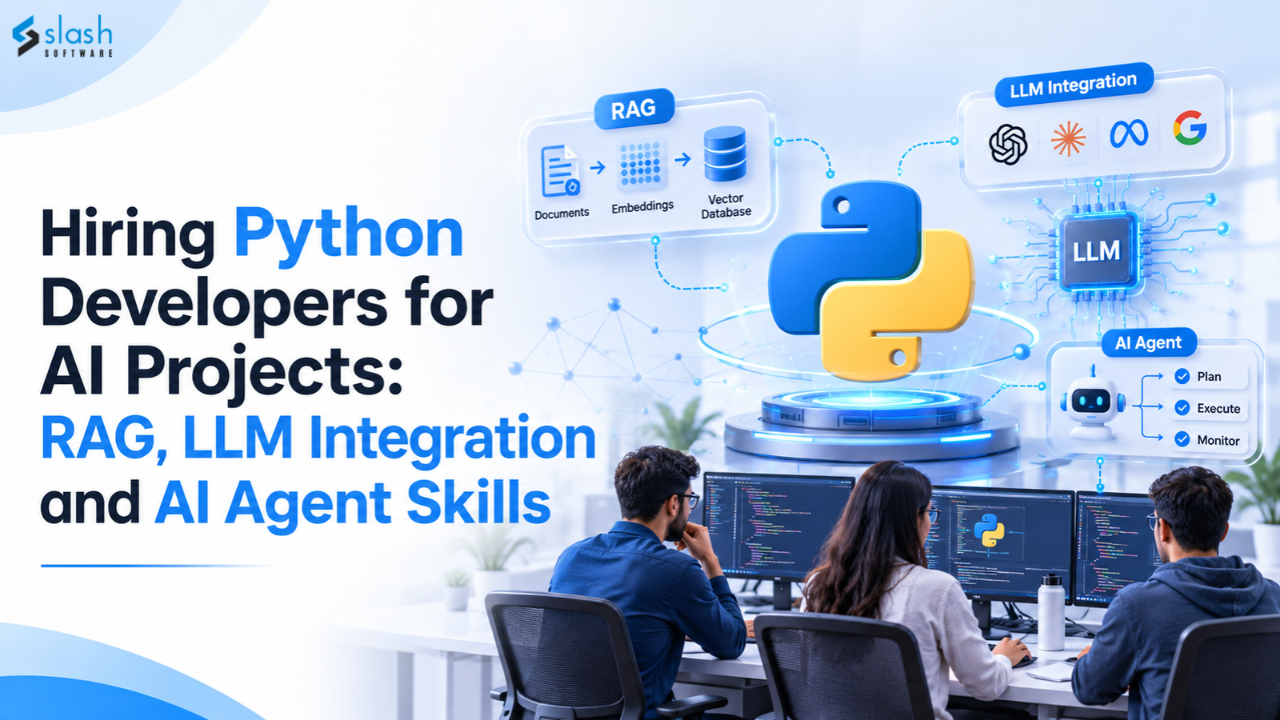



Hiring a Python developer for an AI project requires more than checking their knowledge of Python, APIs, and machine-learning libraries. Someone who can build a chatbot prototype may not know how to improve retrieval accuracy, validate model outputs, prevent prompt injection, or control an AI agent in production.
The skills you need depend on the application. RAG systems require retrieval and evaluation expertise. LLM integrations need reliable API orchestration and structured outputs. AI agents introduce tools, permissions, state, security risks, and failure recovery.
The best candidate is not necessarily the person who knows the most frameworks. It is the developer who can explain why an AI system failed and how to stop the same failure from reaching users.
Short Summary
When hiring Python developers for AI projects, match their experience to the application. RAG developers should understand document pipelines, retrieval, reranking, and evaluation. LLM integration developers need strong API, Pydantic validation, fallback, and cost-control skills. AI agent developers must understand MCP, tool execution, state, prompt injection, approvals, and observability.
These skills should transfer across OpenAI, Claude, Gemini, and open-source models. Evaluate candidates with a small, role-specific exercise instead of relying only on Python questions or framework names.
Why a General Python Developer May Not Be Enough
Python provides a strong foundation for AI development. However, production LLM applications introduce problems that do not usually appear in conventional backend work.
The developer may need to process unstructured documents, design retrieval logic, validate unpredictable model responses, manage conversation state, connect business tools, protect private data, and monitor model behavior.
This work combines backend development, data engineering, AI evaluation, application security, and cloud operations.
Most businesses do not need a researcher who can train a foundation model from scratch. They need a Python engineer who can turn an existing model into a secure, controlled, and measurable business application.
The first hiring question should therefore be: Which part of the AI system will this developer own?
Match the Developer to the AI Project
RAG, LLM integration, and AI agent projects overlap, but they should not use the same hiring checklist.
| AI project | Essential knowledge | Evidence to request |
| RAG application | Document processing, retrieval, reranking, permissions, and evaluation | A retrieval pipeline tested against realistic questions |
| LLM integration | Model APIs, Pydantic, structured outputs, retries, and cost controls | A production integration with validation and monitoring |
| AI agent | Tool calling, MCP, state, permissions, guardrails, and approvals | An agent workflow that handles unsafe or failed actions |
| Enterprise AI platform | Security, tenancy, auditability, deployment, and observability | A production system used by real teams or customers |
A candidate does not need experience with every library or model provider. What matters is whether they understand the underlying failure modes and can explain their architectural decisions.
RAG Developers: Can They Explain a Wrong Answer?
Retrieval-augmented generation gives an LLM access to external information. Its accuracy depends on much more than storing documents in a vector database.
A capable RAG developer should know how to extract and clean information from PDFs, websites, databases, and internal systems. They must decide how to divide documents, preserve metadata, filter results, and enforce existing access permissions.
Important skills include semantic search, keyword search, hybrid retrieval, metadata filtering, query rewriting, reranking, context assembly, and source citation.
Do not stop at asking, “Have you used a vector database?” Give the candidate an incorrect chatbot answer and ask how they would investigate it.
A strong candidate will separate the failure into stages. Was the correct information present in the source? Was the right passage retrieved? Did reranking remove it? Did the passage reach the model? Did the model ignore or misunderstand it?
Each failure requires a different fix.
The developer should also know how to create a test set containing realistic questions, expected answers, and approved sources. Retrieval performance and final-answer quality should be evaluated separately.
Honestly, a developer who cannot explain why an AI system produced a wrong answer is not ready to maintain it in production.
LLM Integration Developers: What Happens When the Model Output Breaks?
Some projects do not need RAG or an autonomous agent. They need an LLM added to an existing application to classify requests, summarize records, extract fields, or support a business workflow.
For this work, backend reliability matters as much as model knowledge.
The developer should understand asynchronous Python, API timeouts, retries, rate limits, streaming, caching, background jobs, and provider fallbacks. The FastAPI concurrency documentation explains how asynchronous and blocking operations should be handled differently.
Structured outputs are equally important. If another system uses the model’s response, it should not accept unchecked, free-form text. The developer should define a schema and validate the result with a tool such as Pydantic.
Ask how the candidate would handle malformed output, a provider timeout, rising token usage, sensitive data in logs, and an unavailable model.
The architecture should not depend unnecessarily on one provider. OpenAI, Claude, Gemini, and open-source models use different APIs, but every integration still needs validation, testing, security, monitoring, and fallback planning.
Current platform knowledge is another useful hiring signal. OpenAI officially shut down the Assistants API on August 26, 2026, and directs new integrations toward the Responses API and Conversations API. A candidate proposing the Assistants API for a new system may be relying on outdated architecture. However, this should be evaluated alongside broader engineering ability, not used as a framework-trivia question.
AI Agent Developers: Who Controls What the Agent Can Do?
An AI agent does more than generate a response. It selects tools, performs actions, maintains state, and may complete several steps before producing a result.
That autonomy creates additional risk.
An agent might update a CRM record, access an internal document, send a message, or issue a refund. The developer must control what it can access and which actions require approval.
Look for experience with tool schemas, state management, idempotency, scoped permissions, approval checkpoints, audit logs, and recovery from partial failures.
The developer should also understand Model Context Protocol, or MCP. The official MCP Python SDK supports standardized connections between AI applications, resources, and tools.
Connecting an MCP server does not make a workflow safe. Tool inputs still need validation. Permissions should follow least-privilege principles, and high-impact actions should require approval.
How Should Developers Defend Against Prompt Injection?
Prompt injection can appear in user messages, retrieved documents, web pages, emails, or tool results. An agent may follow those malicious instructions and expose information or perform an unintended action.
OWASP identifies both direct and indirect prompt injection as significant risks for LLM applications. Its guidance recommends limited privileges, human approval for sensitive actions, separation of untrusted content, and adversarial testing.
A production-ready developer should use tool allowlists, input and output validation, permission boundaries, content isolation, and monitoring. An LLM should never receive unrestricted authority over critical systems.
Can the Developer Run It in Production, Not Just Demo It?
Regardless of the AI use case, the developer must still be a capable software engineer.
The application needs authentication, tests, secure secret management, database design, version control, deployment automation, logging, and monitoring. Experience with FastAPI, Pydantic, Docker, PostgreSQL, cloud infrastructure, and CI/CD is often valuable.
Testing should examine model-output validation, retrieval quality, tool behavior, prompt regressions, provider failures, latency, and cost.
The OpenAI Agents SDK testing documentation covers deterministic testing for tool execution, handoffs, guardrails, retries, streaming, and sessions. These principles remain useful even when the application uses Claude, Gemini, or an open-source model.
Observability also matters. Agent traces may contain model calls, tool activity, handoffs, and guardrail events. Developers must decide what to record while preventing sensitive prompts, customer information, and tool outputs from being exposed in logs.
The Change-One-Requirement Test for AI Developers
After a candidate completes the practical exercise, change one requirement. Add a restricted document, return malformed JSON, insert an untrusted instruction, or make a tool time out.
The candidate’s response to that change often reveals more than the original implementation. It shows whether they can diagnose failures, revise assumptions, and protect the application when conditions change.
A useful hiring process should combine this exercise with an architecture discussion and code review. Keep the assignment focused. A two-to-four-hour task is usually enough to understand how the candidate thinks without demanding a large amount of unpaid work.
| Hiring track | Practical exercise | What to assess |
| RAG | Build retrieval for a small document set | Chunking, citations, evaluation, and failure analysis |
| LLM integration | Extract structured data from inconsistent text | Pydantic validation, retries, and model assumptions |
| AI agent | Build an approval-gated tool workflow | Permissions, state, prompt-injection controls, and recovery |
Ask candidates to explain their individual contribution to previous projects. A portfolio screenshot proves that an interface existed. It does not show who designed the retrieval system, secured the tools, or built the production architecture.
Framework Names Are Not Proof of AI Skills and Other Hiring Mistakes to Avoid
One common mistake is treating framework names as proof of skill. A candidate may list LangChain, LangGraph, LlamaIndex, FastAPI, multiple vector databases, and several agent SDKs without understanding when or why to use them.
Another mistake is hiring only for prototype speed. A demonstration may work with a small dataset and carefully selected prompts. Production applications face missing information, conflicting sources, provider failures, changing permissions, malicious inputs, and unpredictable users.
Domain knowledge is also easy to underestimate. A technically capable developer still needs access to someone who understands the business workflow, source data, compliance requirements, and what a correct result means. Without that context, the developer may build a technically functional system that makes poor business decisions.
Businesses should also avoid expecting one developer to handle product strategy, AI architecture, data engineering, frontend development, QA, DevOps, and security equally well. A senior Python developer may lead several areas, but a complex AI product often requires support from other specialists.
Freelancer, Full-Time Hire or Dedicated Python Developer?
A freelancer can suit a proof of concept, narrow integration, or short technical evaluation. A full-time employee provides long-term product knowledge but requires recruitment time, onboarding, and employment costs.
A dedicated developer or offshore team can support a defined roadmap without requiring the business to build an entire internal AI department.
Whichever model you select, confirm communication expectations, source-code ownership, repository access, cloud-account control, documentation, security responsibilities, and post-launch support.
This guide to hiring dedicated Python developers provides additional criteria for comparing technical skills and engagement models.
A Practical 30-Day Onboarding Plan
During the first week, provide access to business requirements, approved data sources, architecture, security policies, and existing tests.
The second week should produce a thin end-to-end workflow. It does not need every planned feature. It should connect the model, data, application, validation, and monitoring path.
During weeks three and four, test the riskiest assumptions. For RAG, measure retrieval quality. For an LLM integration, test invalid outputs, latency, and provider failures. For an agent, test permissions, prompt injection, repeated actions, approvals, and recovery.
At the end of 30 days, review evidence rather than feature count. Examine test results, traces, response time, cost per task, known limitations, and unresolved risks.
Build a Production-Ready AI Product With Slash Software
Slash Software helps businesses build RAG applications, LLM integrations, AI agents, and production AI platforms.
Support can include an individual developer or a complete team covering AI architecture, Python development, data pipelines, QA, DevOps, security, and system integration.
Businesses planning to hire dedicated Python developers can discuss their data, workflows, model requirements, security risks, and delivery roadmap before selecting a developer or complete AI team.
Frequently Asked Questions
What Python skills are essential for an AI developer?
An AI developer should understand Python architecture, APIs, asynchronous processing, Pydantic validation, testing, databases, deployment, and monitoring. Depending on the project, they may also need retrieval, MCP, tool calling, and agent-orchestration skills.
Does a RAG developer need machine-learning experience?
A RAG developer should understand embeddings, retrieval, reranking, evaluation, and LLM behavior. Deep model-training experience is not always necessary when the application uses existing commercial or open-source models.
What should an AI agent developer know?
An agent developer should understand tools, MCP, state, permissions, prompt injection, guardrails, approval workflows, tracing, idempotency, and failure recovery. Prompt-writing skills alone are not enough.
Do these skills apply only to OpenAI models?
No. The same engineering principles apply to Claude, Gemini, and open-source models. Provider APIs differ, but applications still require validation, testing, security, monitoring, and fallback planning.
Should a business hire one Python developer or a complete AI team?
A focused prototype may need one experienced developer. A production application with proprietary data, multiple integrations, and strict reliability requirements usually benefits from architecture, QA, DevOps, security, and data support.
How can a company verify practical AI-development experience?
Use a small role-specific exercise and ask the candidate to explain their decisions. Discuss previous failures, evaluation results, security controls, tradeoffs, and individual responsibilities.