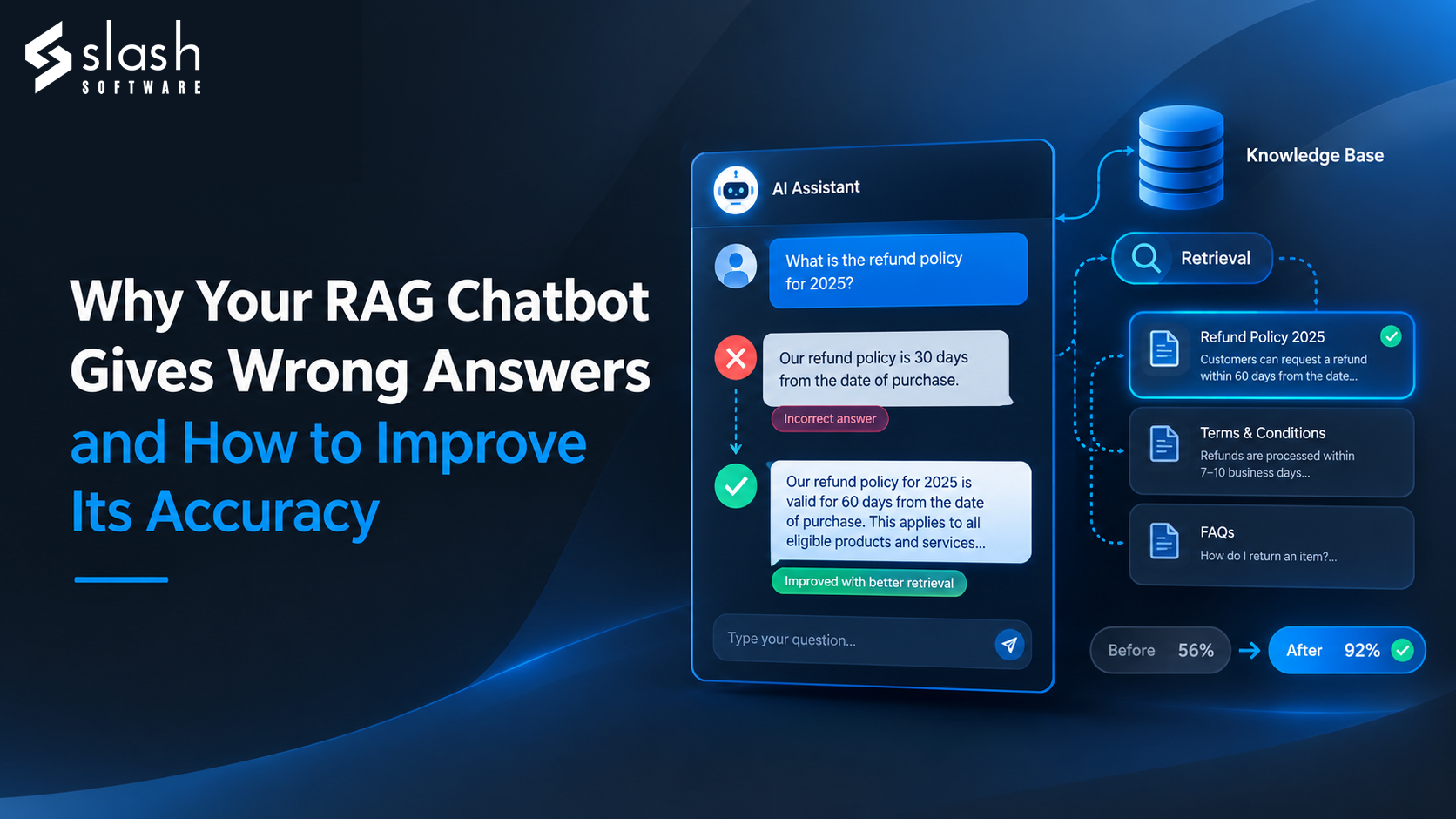



A user asks your chatbot, “How much notice is required to cancel our enterprise contract?”
The chatbot answers, “Customers must provide 90 days’ notice.” That rule appears in the company’s contract guide, so the answer looks reliable. However, the customer’s agreement includes a 180-day exception.
The language model did not necessarily invent the answer. The RAG system retrieved the general rule but missed the relevant exception.
This is why replacing the model rarely solves every accuracy problem. The failure may begin in the source documents, indexing process, retrieval logic, context assembly, prompt, or business workflow.
TL;DR
A RAG chatbot can provide wrong answers even when it uses trusted company data. Common causes include outdated documents, poorly divided content, weak retrieval, missing metadata, excessive context, and prompts that allow unsupported claims.
To improve accuracy, inspect the evidence the chatbot retrieved before changing the model. Strengthen the source data, use semantic chunking, combine keyword and vector search, apply reranking and filters, require citations, and test the system with real business questions. Questions involving live balances, calculations, or transactions should usually connect to an API or database instead of relying only on document retrieval.
Why Can a RAG Chatbot Still Give Wrong Answers?
Retrieval-augmented generation, or RAG, connects a large language model with an external knowledge source. When a user asks a question, the system searches that source, selects relevant passages, and gives them to the model as context.
The model then produces an answer based on the retrieved information.
RAG reduces dependence on the model’s general training data, but it does not guarantee accuracy. If the search retrieves incomplete, outdated, or unrelated evidence, the model may generate a confident answer from the wrong context.
In practice, RAG accuracy depends on three questions:
- Did the system find the correct evidence?
- Did that evidence reach the model in a usable form?
- Did the model answer only from the supplied evidence?
A failure at any one of these stages can produce a wrong response.
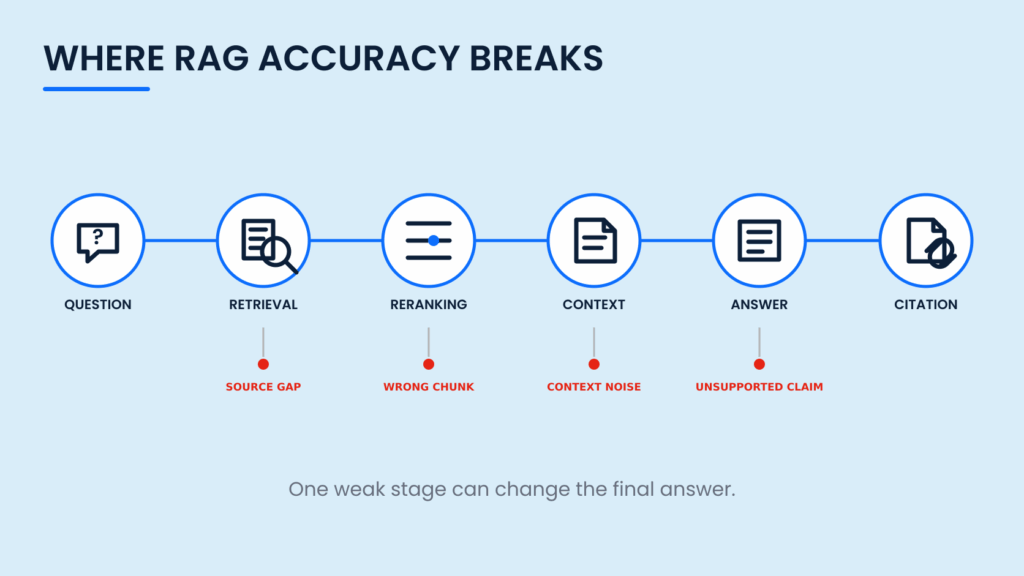
Six Warning Signs That Reveal Where Your RAG System Is Failing
1. It finds the main rule but misses the exception
This often happens when related clauses are stored in separate chunks. The chatbot retrieves the general cancellation rule but not the product-specific or customer-specific exception.
The fix is not simply to increase the number of retrieved passages. First, review whether headings, clauses, tables, and exceptions remain connected during document processing.
Microsoft notes that semantically relevant chunks are important for RAG quality because irrelevant or oversized context can produce inaccurate responses.
2. It answers correctly for one department but incorrectly for another
The same words may have different meanings across finance, HR, legal, and operations. A query about an “approval limit” could retrieve a purchasing policy when the user needs a travel-expense policy.
Metadata can reduce this confusion. Documents and chunks should be tagged by department, product, region, customer type, version, and effective date where appropriate.
The retrieval layer can then filter the search space before ranking results.
3. It cites an outdated policy
A RAG system cannot recognize the latest document unless the knowledge base contains reliable version information.
Old policies, duplicate files, draft documents, and archived web pages can compete with current sources. If the older document is written more clearly, it may even rank higher.
Establish one approved source for each policy. Record effective dates, remove duplicates, and exclude expired content from normal retrieval.
4. It gives a partial answer
A user may ask a question that requires evidence from several sources. For example, approving a vendor could depend on procurement policy, regional tax rules, security requirements, and contract value.
Basic similarity search may retrieve only one part of that evidence.
Query rewriting, metadata filters, hybrid search, and reranking can improve coverage. Hybrid retrieval combines semantic matching with keyword search, which is useful when queries contain exact product names, clause numbers, error codes, or financial terms.
5. It answers confidently when the evidence is insufficient
A helpful-sounding model may fill gaps instead of admitting uncertainty. This creates a dangerous experience: the response is fluent, but the evidence does not support it.
The system prompt should clearly restrict the chatbot to approved context. It should also explain what to do when evidence is missing—for example, ask a follow-up question, provide a qualified response, or transfer the request to a human.
Microsoft’s RAG guidance recommends clearer system instructions and citations when hallucinations continue despite grounding.
6. It tries to answer a live-data question from documents
Some questions are not knowledge-retrieval problems.
“What is our travel reimbursement policy?” is suitable for RAG. “What is the remaining balance in this employee’s travel budget?” requires current data and possibly a calculation.
A document-based chatbot should not estimate live balances, inventory levels, account status, or transaction results. These requests should be routed to an authenticated database, API, ERP, or other operational system.
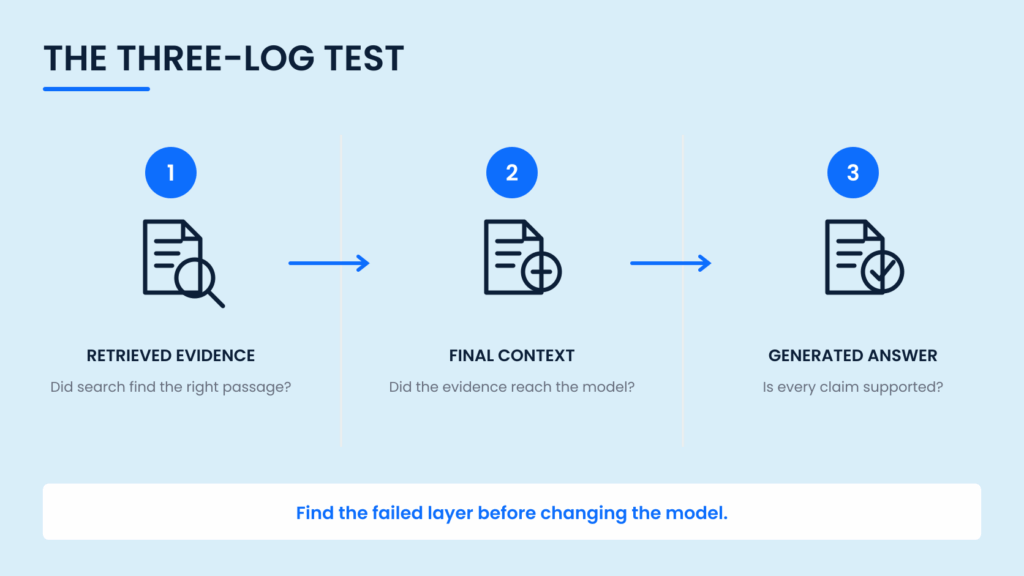
Use the Three-Log Test Before Replacing the Model
When a chatbot gives a wrong answer, inspect three records from the same request.
Log 1: Retrieved evidence
Check the passages returned by the search system.
Did retrieval find the correct document? Did it include the relevant exception? Did an old version outrank the current one?
If the correct evidence is absent here, investigate the source data, chunking, embeddings, metadata, search method, filters, and reranking.
Log 2: Final model context
Next, examine the exact context sent to the language model.
The retrieval system may have found the correct passage, but another component could have removed, shortened, reordered, or buried it. Too many retrieved passages can also dilute the strongest evidence.
If the right passage appeared in the search results but not in the final context, the problem lies in context assembly rather than initial retrieval.
Log 3: Generated answer and citations
Finally, compare every factual claim with the supplied context.
If the correct evidence reached the model but the answer contradicts it, review the prompt, answer format, model settings, citation rules, and refusal behavior.
This three-log approach identifies the failed layer instead of treating every incorrect response as a generic “AI hallucination.”
RAG Failure-to-Fix Guide
| What users experience | Likely cause | First improvement to test |
| The answer misses an exception | Related clauses were separated or not retrieved | Improve semantic chunking and retrieve neighboring sections |
| The answer uses the wrong department’s policy | Search lacks business context | Add metadata filters for department, region, or product |
| The chatbot cites an old rule | Duplicate or outdated documents remain indexed | Add version controls and effective-date filters |
| The answer is related but incomplete | Retrieval returns only one part of the evidence | Use query rewriting, hybrid search, and reranking |
| The response sounds certain without proof | Prompt permits unsupported completion | Require evidence-based answers, citations, and refusal |
| The answer contains an incorrect live value | RAG is being used for operational data | Connect an API or database and validate the result |
How to Improve RAG Chatbot Accuracy
Start with the knowledge base. Remove duplicate content, identify authoritative documents, preserve useful headings, and record ownership and effective dates. Scanning more files will not improve accuracy if the files conflict.
Next, divide documents by meaning. Fixed-size chunks are easy to implement, but they can separate a rule from its qualification. Policies may need section-based chunks, while tables, product manuals, and contracts may require different strategies.
Improve retrieval before upgrading the language model. Test keyword, vector, and hybrid search against a representative question set. Apply metadata filters and use a reranker when the first search returns several plausible results. Official guidance from Microsoft and Google similarly emphasizes evaluating and tuning retrieval rather than judging only the final prose.
Keep the final context focused. More passages do not automatically create a better answer. Include the strongest evidence, necessary neighboring text, and source details without filling the prompt with loosely related content.
Finally, design grounded behavior. Require the chatbot to cite its source, separate facts from assumptions, and state when the available evidence is insufficient.
How Should You Measure RAG Accuracy?
Do not evaluate the chatbot with only a few demonstration questions. Create a test set based on real user requests, including vague wording, abbreviations, exceptions, conflicting policies, and questions that should not be answered.
Track retrieval and generation separately:
- Retrieval success: Did the correct evidence appear in the retrieved results?
- Context relevance: Was the final context useful and free from distracting passages?
- Answer faithfulness: Is each factual claim supported by the context?
- Answer completeness: Did the response address every part of the question?
- Citation accuracy: Does each citation support the nearby claim?
- Abstention quality: Does the chatbot refuse or escalate when evidence is insufficient?
A single “accuracy score” can hide the real failure. Separate metrics make the next engineering decision clearer.
When RAG Is Not Enough
RAG is appropriate for questions answered by documents, manuals, policies, transcripts, and other reference material. It is not the best mechanism for every enterprise request.
Use an API, database query, calculation service, or rules engine when the answer depends on current or user-specific data. Use human review when a decision carries significant legal, financial, medical, or safety consequences.
This routing may require custom software development to connect the chatbot safely with CRMs, ERPs, databases, and other operational systems.
Build a More Reliable RAG Chatbot With Slash
Improving a production RAG system requires more than prompt editing. The complete workflow may involve document preparation, retrieval architecture, model selection, system integrations, security controls, testing, and monitoring.
Slash helps businesses design and improve grounded AI systems through its AI software development services. Working with an experienced AI software development partner can help your organization diagnose failures across the complete evidence pipeline instead of repeatedly changing models without addressing the underlying cause.
Speak with Slash about evaluating your RAG chatbot and creating a practical accuracy-improvement roadmap.
Diagnose the RAG Pipeline Before Replacing the Model
A wrong RAG answer is usually the visible result of an earlier failure. The source may be outdated, the relevant clause may be split, search may retrieve the wrong passage, or the final prompt may contain too much noise.
Start with the evidence trail. Inspect what the system retrieved, what the model received, and whether the answer stayed faithful to that context.
This approach turns a vague accuracy problem into a specific engineering task—and helps teams improve reliability without making expensive changes based on guesswork.
Frequently Asked Questions
Can a RAG chatbot hallucinate even when using company documents?
Yes. It can generate unsupported claims when retrieval returns incomplete or irrelevant passages, the final context is confusing, or the prompt does not require grounded answers.
How can I improve my RAG chatbot’s accuracy?
Improve source quality, semantic chunking, metadata, hybrid search, reranking, context selection, citation controls, and evaluation. Diagnose retrieval and generation separately.
Does using a larger language model improve RAG accuracy?
Sometimes, but it cannot recover evidence that retrieval failed to find. Fix data and retrieval problems before paying for a larger model.
What is the best chunk size for a RAG chatbot?
There is no universal size. The best chunks preserve complete meaning while remaining focused enough for accurate retrieval. Test chunking by document type.
Is vector search enough for accurate RAG answers?
Not always. Hybrid search often performs better when questions contain exact names, codes, dates, numbers, or specialized business terminology.
How do you measure RAG chatbot accuracy?
Measure retrieval success, context relevance, answer faithfulness, completeness, citation accuracy, and appropriate refusal using a representative set of real business questions.