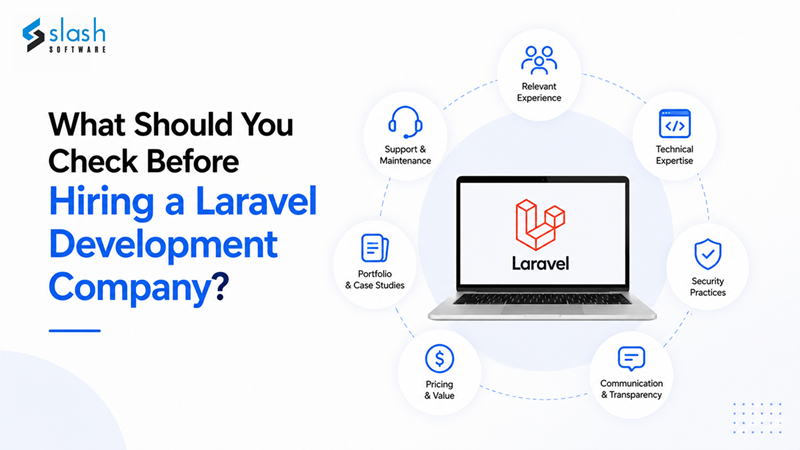



Choosing a Laravel development partner requires more than reviewing hourly rates and portfolio screenshots. The right company should understand your business model, design maintainable architecture, protect sensitive data, test critical workflows, and support the application after launch.
Before signing a contract, examine the company’s Laravel experience, engineering process, security practices, communication model, ownership terms, and ability to scale your product. A structured evaluation helps you avoid technical debt, missed deadlines, and expensive redevelopment.
TL;DR
Before hiring a Laravel development company, check whether it has completed projects similar to yours, uses an experienced technical team, follows documented coding and testing practices, and can explain its approach to security, scalability, deployment, and maintenance.
Ask to speak with the people who will work on your application. Review a technical proposal, not only a sales presentation. Confirm code ownership, repository access, documentation, support terms, and third-party costs before development begins.
Start with your business requirements
A development partner cannot produce an accurate plan from a vague request such as “build a marketplace” or “modernize our portal.” Before comparing companies, define the problem the application must solve.
Identify the primary users, critical workflows, required integrations, expected traffic, security needs, and desired launch date. Separate essential features from features that can wait for a later release.
A capable Laravel team should challenge unclear assumptions during discovery. It should ask how the business operates, where data comes from, what happens when a transaction fails, and how success will be measured. A company that immediately provides a fixed price without investigating these areas may be estimating an interface rather than a complete system.
1. Does the company have relevant Laravel experience?
General PHP experience is not the same as deep Laravel expertise. Laravel includes established approaches for routing, dependency injection, queues, events, caching, authentication, authorization, testing, and database operations.
Ask for two or three projects that are technically similar to yours. A company building an ecommerce platform should demonstrate experience with payments, inventory, order workflows, and high-traffic events. A healthcare or fintech application requires stronger evidence around access control, auditability, and sensitive data.
Do not judge experience only by the number of years a company has existed. Ask what its team actually delivered, which technical problems it faced, and how it resolved them.
Useful portfolio evidence includes:
- A live or demonstrable application
- A clear explanation of the company’s responsibilities
- Measurable technical or business outcomes
- A reference who can discuss delivery and support
Four specific points are enough. A long gallery of unexplained screenshots provides little evidence of engineering quality.
2. Who will actually build your application?
The people attending the sales call may not be the people assigned to your project. Ask for the proposed team structure and the experience level of each role.
A typical Laravel project may require a solution architect or technical lead, backend developers, frontend developers, a quality-assurance engineer, a UI/UX designer, and a project manager. Smaller projects may combine some responsibilities, but accountability should remain clear.
Request a technical discussion with the proposed lead developer. Ask how that person would divide your application into modules, manage permissions, handle failed jobs, and monitor performance. You do not need to judge every technical term. You need to determine whether the lead can explain decisions in clear business language.
Also confirm whether developers are dedicated to your project, partially allocated, or replaced as availability changes.
3. How strong is its architecture and code-quality process?
A Laravel partner should design for maintainability, not simply make each feature work. Poorly organized code can slow every future release and make defects harder to diagnose.
Ask how the company conducts code reviews, manages branches, documents decisions, and checks third-party packages. Confirm that it uses version control and gives you appropriate repository access throughout development.
The company should also explain its approach to database design, API architecture, background jobs, caching, error handling, and logging. Laravel provides tools for queues, events, testing, authorization, and other application concerns, but using the framework does not automatically produce good architecture.
Laravel describes itself as a progressive framework that supports features such as dependency injection, unit testing, queues, and real-time events. These capabilities help teams build scalable applications when they are applied deliberately.
4. What testing is included?
“QA included” is too vague. Ask what will be tested, who performs the testing, and which tests will be automated.
A credible plan should cover important user journeys, validation rules, permissions, API behavior, database changes, integrations, and failure conditions. Payment processing, account access, subscription changes, and administrative actions deserve particular attention.
Laravel supports unit and feature testing through Pest and PHPUnit and includes commands for running an application’s test suite. Its HTTP testing tools can verify requests, authentication, validation, JSON APIs, file uploads, and other behavior. Laravel’s testing documentation explains these built-in capabilities.
The goal is not to automate every visual detail. The goal is to protect the workflows that would create the greatest business damage if they failed.
Laravel company evaluation table
Use this table to compare shortlisted companies consistently.
| Evaluation area | Strong evidence | Warning sign |
| Relevant experience | Similar systems with explainable outcomes | Unrelated screenshots or generic claims |
| Technical team | Access to the proposed technical lead | Only salespeople join discussions |
| Architecture | Clear decisions about modules, data, APIs, and scale | Architecture is postponed until coding |
| Testing | Defined manual and automated test coverage | “Developers test their own work” |
| Security | Threat assessment, access control, reviews, and patching | Security is discussed only before launch |
| Communication | Regular demos, written updates, and visible tracking | Progress is reported informally |
| Ownership | Client controls code, accounts, and documentation | Vendor retains key access or dependencies |
| Support | Response times and maintenance scope are documented | Support is offered without clear terms |
5. How does the company approach security?
Laravel contains useful authentication and authorization features, but secure software depends on correct implementation. Laravel distinguishes authentication from authorization and provides gates and policies for controlling actions on resources. The authorization documentation explains this separation.
Ask how the team manages roles, secrets, input validation, dependency updates, logging, backups, and access to production systems. It should also have a process for reviewing common risks such as broken access control, security misconfiguration, injection, and authentication failures.
For regulated projects, confirm whether the team understands your specific obligations. Do not accept a general promise that the framework makes the application compliant.
6. Can the application scale and operate reliably?
Scalability does not mean adding complex infrastructure before it is needed. It means avoiding design decisions that prevent sensible growth.
Give each company a realistic usage scenario. Ask how the proposed system would handle ten times the current traffic, a slow third-party API, a failed background job, or a sudden increase in database activity.
The response may include caching, queues, database indexing, horizontal scaling, rate limits, or asynchronous processing. The correct answer depends on your application. What matters is whether the company connects its recommendations to actual risks instead of listing fashionable technologies.
Deployment planning should also cover separate environments, configuration management, automated releases, database migrations, rollback procedures, backups, and monitoring. Laravel supports managed deployment options, including Laravel Cloud, but the team should recommend infrastructure based on your workload, budget, and control requirements.
7. Is the engagement model transparent?
A fixed-price model can work when requirements are stable and acceptance criteria are detailed. A time-and-materials model is usually better when the product will evolve through research and user feedback. A dedicated team can suit a longer product roadmap requiring continuous development.
| Engagement model | Best suited for | Main risk to manage |
| Fixed price | Clearly defined, limited scope | Change requests and excluded work |
| Time and materials | Evolving requirements | Weak budget or priority control |
| Dedicated team | Long-term product development | Unclear team utilization |
Regardless of the model, request a breakdown of discovery, design, development, testing, deployment, and support. Confirm which expenses are separate, including cloud hosting, email delivery, payment services, monitoring tools, and commercial packages.
The lowest quote may omit essential work. Compare assumptions and deliverables before comparing totals.
8. Who owns the code and infrastructure?
Your agreement should state that you own the custom source code after payment. It should also cover designs, documentation, database structures, deployment scripts, and other project assets.
Use company-controlled accounts for the source repository, cloud platform, domain, analytics, payment gateway, and important external services whenever practical. The vendor can receive appropriate access without becoming the permanent owner of your infrastructure.
Also confirm how the company will transfer knowledge if the engagement ends. A clean handover should not depend on one developer’s memory.
Questions to ask before making the final decision
During the final interview, ask the company to explain:
- Which past project is most similar to ours, and why?
- Who will lead the technical work?
- What assumptions could materially change the estimate?
- Which critical workflows will receive automated tests?
- How will security and production access be managed?
- What happens if a milestone is late or fails acceptance?
- What support is available after launch?
These questions reveal more than asking whether a company uses the latest Laravel version.
Key takeaways
The Best Laravel Development Company for your project is not necessarily the largest agency or the cheapest provider. It is the team that understands your business risk, provides relevant evidence, communicates clearly, and makes sound technical decisions.
Verify who will perform the work. Examine architecture, testing, security, deployment, ownership, and support before signing. Compare companies using consistent criteria and require important commitments to appear in the proposal or contract.
A careful selection process takes longer at the beginning, but it reduces the risk of stalled development, fragile software, and costly vendor changes later.
Frequently asked questions
How do I verify a Laravel developer’s experience?
Review relevant applications, discuss the developer’s exact responsibilities, inspect a code sample where possible, and conduct a technical conversation about architecture, testing, security, and performance.
Should I choose a US or offshore Laravel team?
Choose according to capability, communication, delivery process, and total value. An offshore team can provide access to a broader engineering team at a competitive cost, but working hours, ownership, communication, and quality controls should be documented.
What should a Laravel development contract include?
It should define scope, milestones, acceptance criteria, payment terms, intellectual-property ownership, confidentiality, security responsibilities, change management, warranties, support, and termination procedures.
How long should I evaluate a Laravel company?
A focused evaluation can usually be completed in one to three weeks. Complex or regulated projects may require a paid discovery phase before the final development commitment.